Cathedral Choral Society Selects Catherine Ort-Mabry as Interim Executive Director

October 21, 2024 

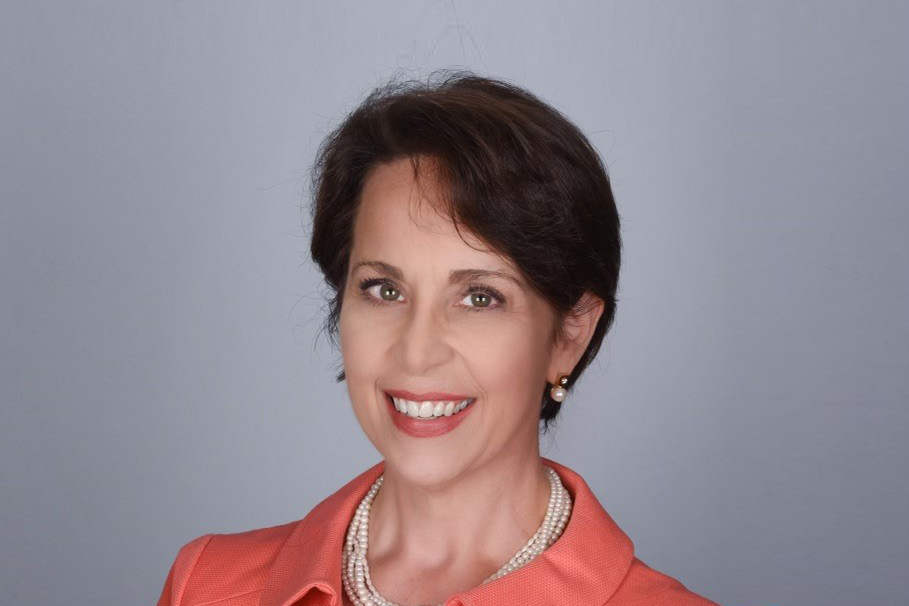
Washington, D.C. – Sarah Holmes, president of the Cathedral Choral Society (CCS) board of trustees, announced today that Catherine Ort-Mabry, CAE, a trusted executive and board advisor with extensive nonprofit communications and engagement expertise, will serve as CCS’s interim executive director beginning October 28th. 

Ms. Ort-Mabry is a compelling and effective leader with deep experience in helping large-scale nonprofit membership-based organizations define and deliver member value. She recently served as chief marketing and communications officer for the American Society for Microbiology (ASM), one of the largest professional societies dedicated to the life sciences. During her tenure at ASM, Ort-Mabry developed programs that exceeded goals in customer satisfaction, membership recruitment and retention, media exposure, and digital reach. Ms. Ort-Mabry is also Chief Executive Officer of C O M Solutions, a consulting firm that partners with purpose-driven organizations to meet their strategic priorities by activating their key stakeholders. In addition to her professional expertise, she has served as a member of the CCS soprano section for more than 25 years.  

Ort-Mabry will provide leadership and support to the CCS team while the organization begins a national search for its next executive director. Her efforts will focus on staff and operational leadership, board governance, and revenue enhancement through marketing and fundraising oversight. 

“The Cathedral Choral Society is strong and thriving thanks to the powerful combination of excellent leadership, exceptional artistic vision and exemplary performances, and I am honored to be able to be part of its continuing success,” Ort-Mabry said. “It’s a true delight to sing with this amazing group of artists, and now I’ll be able to contribute both on stage and behind the scenes.” 

Ms. Holmes stated, “I am delighted that Ms. Ort-Mabry has agreed to serve as our interim executive director. She brings a wealth of experience in non-profit work and has a decades-long devotion to the Cathedral Choral Society.” 

CCS’s music director Steven Fox noted, “Catherine’s experience and long history with CCS is a perfect fit for our goals and vision this season. It is a year full of collaborations, with the Baltimore Symphony Orchestra, Chanticleer, and a host of extraordinary soloists. We’re excited to welcome Catherine to CCS as we begin this special season. We know she will lead us to great heights.” 

Ort-Mabry’s selection follows the departure of Christopher Eanes, CCS’s executive director since 2019, who announced his departure in September to assume the role of president and CEO of Chorus America, the national advocacy and membership organization for choruses throughout North America. The CCS board of trustees has formed a search committee to guide the recruitment and hiring of its next executive director. Additional information about the search process will be shared in the coming weeks. 
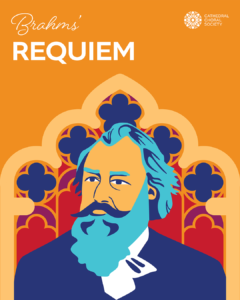
Before The Downbeat: Brahms’ Requiem

Before The Downbeat is a study guide by and for the Cathedral Choral Society in preparation for its concerts. Previously distributed in print form to singers only, we are thrilled to present this content to all our audiences in digital form.

Ein deutches Requiem is a watershed not only in Johannes Brahms’s development as a composer but also in the evolution of the Requiem as a musical form from its strictly Roman Catholic liturgical function to a musical vehicle by which to explore, through non-liturgical and even non-Biblical texts, the meaning of death, mourning and consolation.
First Washington Performances

At the turn of the twentieth century, choral music in the nation’s capital was presented primarily by church choirs. On March 16, 1905, the choir of the now-deconsecrated Trinity Episcopal church (First and C Streets, NW) gave the first known Washington performance of Brahms’s Ein deutsches Requiem, in English, under the direction of Oscar Franklin Comstock but with organ only. Five years later, The Choral Society of Washington, D.C. gave the next known complete performance in 1910.

The Washington Choral Society, a precursor to the Cathedral Choral Society, gave the first complete performance with orchestra led by its founding director Louis Potter, again in English, on January 28, 1937, in this Cathedral to mark the first anniversary of the death of England’s King George V.

The Requiem, according to the Evening Star, drew “an audience beyond the capacity of the cathedral. Many left, not being able to find even standing room.” (At that time, the Cathedral’s grand space consisted only of the Great Choir, the chapels of St. John and St. Mary, the Crossing and the North Transept.) It was, the reviewer wrote, “an ambitious undertaking, but the chorus of nearly 100 voices accompanied by the organ, played by Robert G. Barrow [the Cathedral’s second organist and choirmaster], a good size orchestra [members of the nascent National Symphony Orchestra], acquitted itself in praiseworthy manner.”

The Cathedral Choral Society’s first performance took place in Constitution Hall on October 29, 1952, as part of the National Symphony Orchestra’s 20th Annual Founders Day Concert, marking the NSO’s third decade on the Washington musical scene. The Evening Star reviewed “a magnificent performance,” adding, “To Paul Callaway, director of the [Washington and Cathedral Choral] Societies, goes the highest praise for his accomplishment, and the ovation accorded him, when he was brought out to share the acclaim with the soloists and [NSO conductor] Dr. [Howard] Mitchell, was the audience’s encomium.”

“The voices of the singers are beautiful in ensemble, matched in purity of tone, in expressiveness and in security of pitch. The group produces pianissimos of unusual loveliness and reaches climaxes with rich tonal volume. Throughout, the nuances were superbly fashioned and the clarity of enunciation was a pleasure to hear . . . . Such singing as the Choral Societies did last night alone would have made the concert memorable.”

Dr. Callaway conducted the work again in 1959, 1980, and for the Society’s 25th season program that included the Washington premiere of Leonard Bernstein’s newly minted Chichester Psalms. In 1985, Richard Wayne Dirksen, Callaway’s successor, concluded his season as the Society’s interim music director with Ein deutsches Requiem. Dr. J. Reilly Lewis conducted three performances, most recently in 2013.

On October 20, 2024, Music Director Steven Fox is leading his first reading with the Cathedral Choral Society.

Guy’s Requiem

Guy’s Requiem
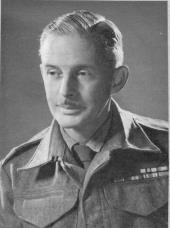
is the true story of Guy Nicolson (1895-1964), a decorated British veteran of World War I and Rhodes Scholar, who later became famed headmaster of Ridge School in Johannesburg. When World War II broke out, despite his age, he joined the staff of the South African 2nd Division as a captain. On June 21, 1942, Nicolson was captured in the disastrous fall of Tobruk during the North African Desert Campaign. He was held prisoner in Offizierlager XIIB, a German POW camp for British officers at Hadamar.

Nicolson used the intellectual and physical skills honed as a Rhodes Scholar to keep up the spirits of his fellow prisoners. Despite oppressive captivity and perilous escape attempts, he also set out to fulfill his lifelong dream to lead a symphony orchestra of prisoner-musicians in a full performance of Brahms’s Ein deutsches Requiem.
The Nazis exploited the orchestra for propaganda purposes, giving them equipment, music, and rehearsal facilities, as seen above. On March 8, 1945, Nicolson led the prisoners in a performance of the first, second, fourth, and fifth movements of the Brahms Requiem. The day before, U.S. forces secured the crucial Ludendorff Bridge over the Rhine near Remagen.

(c) 2024 Margaret Shannon
Reprinted with permissions from
Prelude, Vol. XXII, No. 1 (Fall 2024)

As Vibrant As Ever: Reflections on Choral Music Today

Some reflections from outgoing Executive Director Christopher Eanes; Dr. Eanes will leave the Cathedral Choral Society on October 25 to begin a new role as President & CEO of Chorus America. For more information, click here.

Choral singing is one of the most ancient and universal art forms. The simple act of singing together has played a role in communities throughout the world, all the way back to the beginning of recorded history. 

Perhaps because the art is so universal, we rarely stop to ask ourselves “why?” Why do we make art in this way, and what is the role of an organization like the Cathedral Choral Society in today’s complex world? 

When we come together to sing together, it is an act of community building: we need to trust our neighbor to breathe at the same time as us and to sing the correct pitch and vowel, as we each do our part in service to the musical score. By doing this, we foster personal connections and build empathy for those around us.  

Attending a live concert is itself an act of community; surrounding yourself with others, whether you know them or not, and engaging with the music is a shared experience that cannot be replicated on any other day or in any other place; it is unique to that moment.  

This is crucial in a time when we are living more solitary lives. The U.S. Surgeon General has declared loneliness and isolation a national epidemic; to address the issue, he recommends that we “Cultivate values of kindness, respect, service, and commitment to one another.” The best choruses embody these values, and I have a hunch it is one of the reasons that CCS singers stay in the chorus for so long. (It is not unusual for a CCS singer to have multiple decades of membership under their belt.) 

Every so often, a writer will publish an article lamenting what they feel is the decline of interest in and support for classical music in the United States. I wish, just once, that these writers would include choruses in their accounting. In the U.S., fifty-four million people sing in choruses. It is by far the most participatory art form in the country, and it is as vibrant and healthy as ever. At CCS, we have seen record numbers of folks turning out to audition, and our audience numbers are back to pre-pandemic levels (and then some). 

Why is this? In this digital age, I think there is something compelling about the fact that choral singing is an entirely analog art form. There’s just nothing like being in the room when a chord locks, perfectly in tune, and the individual notes add up to something far greater, much the way that people are stronger together than we are individually. There comes a resonance within us, connecting us with our ancestors and our neighbors and awakening in us the very essence of what it means to be human.